Becoming a Soccer Coach in the NCAA environment is a far different spectacle than becoming a coach in any other setting. In full time Professional Soccer clubs, the Head Coach and backroom staff have two primary responsibilities. The first is to develop and improve the players who are part of the roster. The second and most important is to win Soccer matches. In today’s environment with the amount of financial investment being made by Chief Executives and Owners of Soccer clubs, the pressure is mounted on the coaching staff to win games right away. This goes against coach’s in the professional game because if the levels of investment are not met with the wins that the owners are asking for, the coach will lose his/her job and the club will turn to somebody who they feel can get the job done. In order to grasp just how much money is being invested into clubs at the top of the sport, here is a slideshow of the top 10 investors and how much they’ve put into clubs in England’s top league. https://www.dailystar.co.uk/sport/football/626090/Premier-League-owners-most-money-richest-investments-club-Abramovich-sportgalleries
The coaches are the one’s deemed responsible to produce the wins whilst having there backs against the wall with owners and Chief Executives breathing down their neck. Building a winning culture whether it be in a professional club or NCAA program, doesn’t happen overnight. Coach’s need time.
The strongest and most watched Soccer league is undoubtably the Barclays Premier League, however the coach’s job security is under constant threat, below is a great insight into the life expectancy of Premier League managers https://www.businessinsider.com/premier-league-manager-tenures-shorter-than-ever-2018-5?r=US&IR=T
It cannot be disputed that Jose Mourinho has been at the pinnacle of Soccer from a coaching standpoint for the past two decades. Having managed some of the most recognised clubs in world Soccer such as: Real Madrid, Inter Milan, Manchester United and Chelsea. Mourinho was highlighted for his meticulous preparation when stepping into Chelsea, by team captain John Terry.
‘’He’d be out there at 8am, putting out cones, making sure there were enough bibs, enough balls. He brought ballboys into the training ground to make sure we would get balls back on the pitch as soon as possible. As a group of players, not just me, we all took note of how good he was right from the start.’’ (Terry, 2019)

For the full account of John Terry’s time working under Jose Mourinho, it can be found here at https://www.coachesvoice.com/my-inspiration-john-terry/
Having touched upon the responsibilities of coaches in the professional setting. Its imperative to realise Soccer coach’s within the NCAA have a duty not only to develop the players on the roster. But to develop those players as men or women off the field. Enrolling into college, it’s a critical four years of that student-athlete’s life transitioning through young adulthood. Balancing academic studies with athletic commitments is challenging. So it’s the coaches job to make life as easy as possible for their players and provide the best platform possible, in order for each and every player on the roster. I believe it is the level of preparation that will separate the very best soccer coaches from the average soccer coaches. Preparing an on field practice session, it’s the hand-written diagrams on paper, the footnotes on each drill that may seem bizarre to an onlooker, but its those minor details that ensure you as a coach, will deliver the best session possible. Its also important to realise at the NCAA level, soccer programs do function like a full time professional teams. With practice every day, video analysis sessions, team lifting sessions with assigned strength & conditioning coaches, that is only on the athletic side too. Here is a number of short hand diagrams that I have used in past practices that have improved the quality and flow of some sessions.

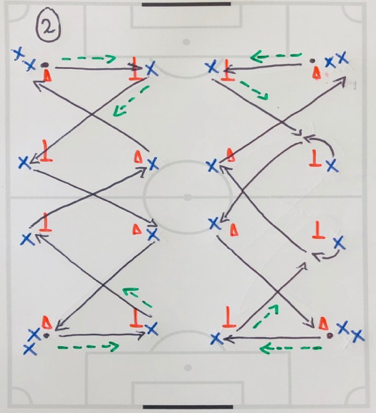
Cramming a piece of paper that has been folded at least seven times and appears all creased when I open it may not seem very professional, however it’s a small resource that I often refer to which helps me explain to the players what exactly it is I am looking for.
In the big picture this level of preparation over time accumulates to big results. It works in step by step process. Firstly, as a coach you are delivering practice sessions that flow and challenge the players so that they are having to think and solve problems themselves. This is appreciated by the players as they reflect on the session by thinking ‘’Wow that was a great session coach just put on for us today’’. If this happens day after day, there is a sense of belief growing through the collective, and the team are starting to build momentum that naturally progresses into the match day. Belief is the most important attribute any team can have when walking onto the Soccer field. Phil Neville who is currently Head Coach of England Women’s Team, who made the Semi Finals of this year’s Fifa Women’s World Cup in France, had a number of insightful memories into his playing career and talks about some of the coach’s he worked for and what made him the coach he is today.
Phil Neville also gives a great account of his time working with the England Women’s National Team here at https://www.coachesvoice.com/phil-neville-england-womens-world-cup/
Ultimately as a coach you cannot go out and win games of soccer for your team, its up to the players. Having said that if all of the preparation is done well enough and the sessions building up to the match are of a certain level you as a coach demand from your players, then you have given the team every chance of winning soccer matches. No matter what NCAA program you look at, the pressure to win matches is equally the same with coaches being evaluated on how many matches they win. At the roots of every successful program, is a coaching staff that is fixated on the smallest of details and prepare better than anyone in order to achieve the goals they have set prior to the start of the season.
 NCAA Soccer - A Coach's Life